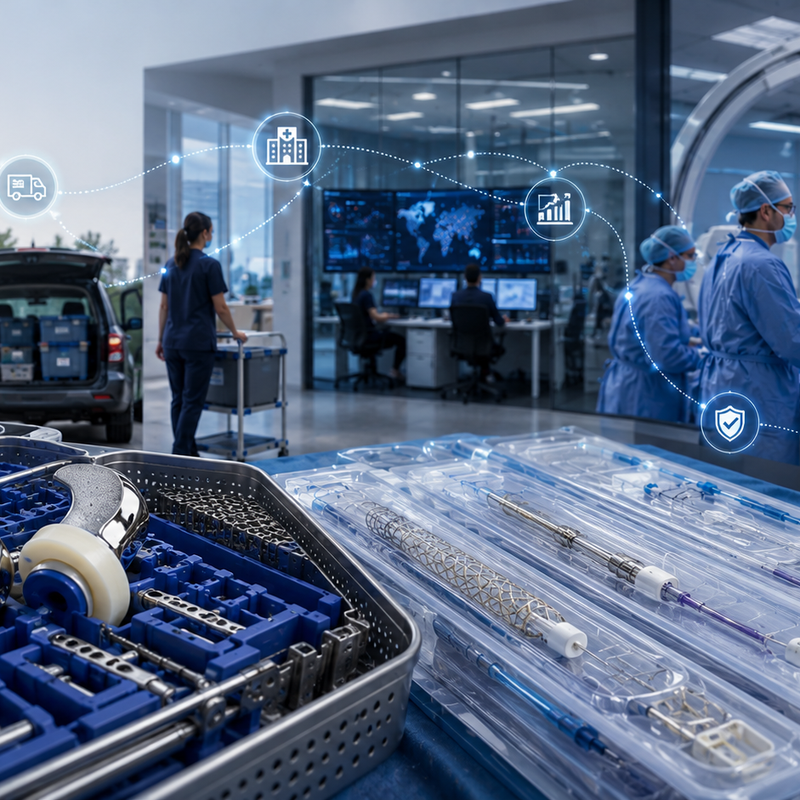

Your ERP can tell you what every implant costs. It can't tell you where any of them are. And that means you probably overstocked out of an abundance of caution. That isn't cheap.
That's true whether you rented your system of record or built your own. Plenty of large manufacturers hit a point where your ERP— built for financial control, not medical device's last mile — starts to throttle how they actually operate, so they build their own. It's a real accomplishment, and a smart read of the problem: the standard ERP was never designed for consignment, loaner trays, and field-managed inventory.
But while building your own solves the part SAP and Oracle got wrong about your back office, it also inherits the part they got wrong about your field. The system of record still can't tell you where your inventory physically is — and that gap only widens as the next acquisition closes, and the one after that. Somewhere in the middle of integrating the third sales force in four years, the quieter problem surfaces: the ERP knows what every product costs and where every PO sits, but not where your inventory is right now, or where it's needed next.
That gap doesn't live in the back office. It lives in the field. And for most large MedTech manufacturers, the field is where the majority of the inventory is.
The Math That Makes This Urgent
When the majority of your inventory is consigned — sitting in hospitals, in rep trunks, in territory storage you don't directly control — your system of record describes the fraction you see well and estimates the rest. That gap is real with a single sales force. Every acquisition multiplies it.
Each company you buy brings its own way of tracking consignment. Its own cycle-count rhythm. Its own habit for how a rep decides whether to request more stock or hunt down what's already in the next territory. Your ERP absorbs their master data on go-live day. It does not absorb their behavior.
So you end up with one system of record sitting on top of three or four field operations that never actually merged.
The cost lands in three places. Financially, finding and moving the stock that's already nearby is a manual, error-prone scramble to avoid shipping from a central location — so teams place extra inventory to buffer against the inaccuracy, inflating the demand signal and tying up working capital against stock that isn't turning. Operationally, you can't predict where stock is needed next quarter because you can't see where it is this week. And the regulatory exposure compounds quietly: the traceability gaps from each integration never got cleaned up, so consignment instruments carry unclear chain-of-custody and implantable devices carry documentation gaps that only surface during a recall or an FDA inquiry, on the worst possible timeline.
A Homegrown ERP Doesn't Close This Gap. It Exposes It.
The instinct, having built the platform, is to extend it. Add a field module. Bolt on a view. The same is true of bolting it onto your CRM — a system of record, ERP or CRM, is built to store what happened, not manage what's happening by the hour.
Field inventory isn't a reporting gap you can query your way out of. It's a live operational layer: case scheduling, consignment tracking, loaner kit movement, lot-level traceability, all of it changing by the hour across thousands of locations. An ERP is built to be the durable record of what was sold and billed — what already happened. The field needs a system built to manage what's happening right now. Asking one platform to do both is how companies end up with an expensive system of record and reps still reconciling on spreadsheets.
The companies that solved this didn't replace their ERP. They added a field-inventory layer on top of the system they already trusted, so every rep from every acquired team sees the same truth about every tray, kit, and consignment location.
What That Looks Like in Numbers
These aren't projections. They're what companies that brought the field layer in at the start of integration have actually seen.
One of the largest orthopedic manufacturers, in its own public reporting, credits inventory management with $220 million in cost avoidance, cutting days inventory on hand 20% (roughly 67 days) while revenue grew. Another global med device manufacturer, consolidating a multi-entity field operation, put 15 separate inventory, scheduling, and loan-management vendors onto one platform and pulled $100–120 million in surgery assets out of the field. A third, integrating an acquired ortho franchise, cut field inventory 27% in twelve months and went live in 45 days without a full ERP integration.
That last number is the one that matters most to a company that just built its own ERP.
Because the field layer reads from the system of record rather than replacing it, it goes live in 6–8 months on average. Not a multi-year project, and not a rip-and-replace of the platform you spent years building. It adds the one thing your ERP was never designed to give you: a live picture of where your inventory is, and where it's about to be needed.
The Window Is the Integration, Not After It
The most expensive version of this problem is the one you fix two years too late, after the workarounds each acquired team built have hardened into how you operate. The companies that avoid it bring field inventory into the integration plan before the reps adapt, so there's no "their way" to fall back on, because there's no gap to fill.
If you're a serial acquirer running mostly-consigned inventory, the field layer is the part of your stack that compounds in value with every deal you close. The ERP was the hard part. This is the part that finally lets you see what it's managing.
Schedule a 20-minute executive walkthrough to quantify the field-inventory gap inside your organization, and what closing it is worth before your next integration.
About the Author