
Key Takeaways
- Legacy methods hit a ceiling. Paper, spreadsheets, barcode scans, and manifests work at low volume — they break down under multi-site complexity and the reverse-logistics load of loaner and consigned inventory.
- RFID and BLE solve different problems. RFID confirms checkpoints; BLE gives continuous location. Mature programs run both, matched to use case, not picked as an either/or.
- This is a leadership issue now, not just an ops one. Working capital scrutiny, M&A-driven system fragmentation, sterile processing staffing shortages, UDI and recall compliance, rep productivity, and connected-device security all intersect with tracking today.
- Hardware without integration is just data. Scans that never reach billing, compliance, or replenishment systems produce visibility without action.
- The numbers are real. Field and loaner inventory commonly runs 25–50% above need; carrying costs run 8–15% of related revenue; RFID deployments have driven inventory reductions of 20–40%.
- Movemedical's own results move past the industry range — 20–30% reduction in unnecessary supply spend across more than 20 million surgeries.
Instrument tracking failures don't show up in a board deck as a single line. They show up as tied-up working capital, compliance exposure, and hours your best people spend recounting trays and chasing lot numbers instead of generating revenue.
That's not an operations problem. It's a capital-efficiency and compliance problem that happens to live in a supply closet.
Where Most Programs Stand Today
Most organizations aren't starting from zero. Paper logs and count sheets still run in facilities where volume is low enough to get away with it, and spreadsheets add flexibility, but are only as accurate as the last person who remembered to update the file. Barcode and 2D scanning improved on both, giving reliable check-in and check-out control, though a scan captures a moment, not a continuous location. Manifest-based loaner tracking works cleanly for a single shipment but doesn't hold up against the reverse-logistics load of sets moving between sites, sterilization, and returns. Tray-count reconciliation remains, in most facilities, a manual and high-pressure last line of defense before a tray enters the OR.
These methods hold up at low volume with a wide margin for error, but fail under multi-site complexity, high loaner volume, and the reverse logistics of inventory that's owned, loaned, and consigned inside the same storage room.
RFID, Bluetooth, and What Comes Next
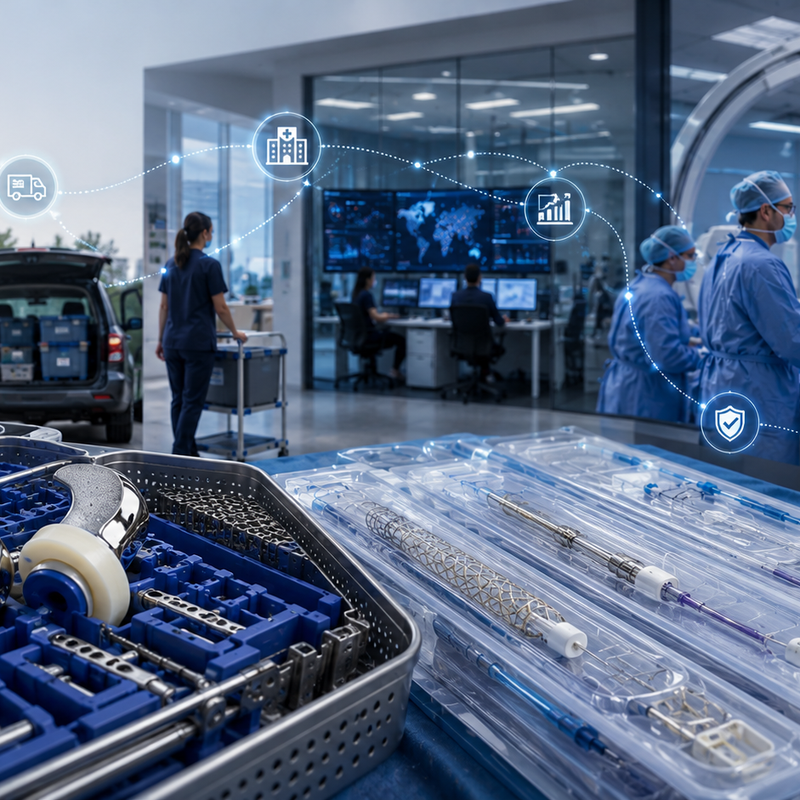
RFID has matured well past pilot programs. A passive or active tag gives each instrument or tray a unique identifier, read automatically at fixed checkpoints, a dock door, a sterilization cabinet, a supply room shelf, with no line-of-sight scanning required. It fits high-value trays, loaner kits, and sterilization-cycle tracking, where the goal is confirming proof of delivery and status at defined points.
Bluetooth Low Energy (BLE) trades some of that read range for continuous location at lower power draw. RFID confirms an item passed through a checkpoint; BLE reports where it is right now, inside a building, close to real time. That makes it well suited to in-building asset location and case-cart tracking, where moment-to-moment position matters more than checkpoint history.
Computer vision and tray-imaging are the next wave, verifying tray counts by comparing an image against an expected configuration. Today it's a strong complement to manual reconciliation; within a few years, it will likely carry a larger share of the workflow. IoT sensor tags monitoring condition and sterility status are following the same trajectory.

No single technology wins outright. The right stack matches the use case: loaned, owned, or consigned; high-value or commodity; single site or national footprint. Most mature programs run more than one method deliberately, side by side.
Why This Is Now a Leadership Conversation
Instrument tracking used to live entirely inside operations. It doesn't anymore, and the reasons are specific:
- Working capital scrutiny. Inventory sitting in field and loaner stock is capital that funds nothing else. Finance leadership wants operations to justify every dollar of carrying cost, and "we need it to be safe" no longer answers the question.
- M&A and portfolio consolidation. Companies built through acquisition often run different tracking systems and standards across business units — creating blind spots exactly when standardization matters most.
- Sterile processing and OR staffing shortages. With fewer hands available to catch errors manually, the tracking system has to prevent mistakes rather than log them.
- Compliance and traceability. UDI, lot- and serial-level recall readiness, and full audit trails are now baseline. Answering a recall question in minutes, not days, is table stakes.
- Rep time and productivity. Every hour reps spend counting trays or chasing a missing screw is time not spent with a surgeon; a direct, measurable cost.
- Connected-device security. As tracking hardware networks together — BLE beacons, RFID readers, cloud dashboards — IT and security leadership have a legitimate stake in a decision that used to belong to operations alone.
This is the conversation already happening inside finance, IT, and the C-suite. It stopped being a back-office decision the moment inventory became a capital-efficiency question
The Structural Answer to a Structural Problem
RFID and BLE tell you where something is. They don't tell you what to do next, and a scan that never reaches a billing, compliance, or replenishment system produces visibility without action.
Movemedical is built to be the layer that turns tracking data into decisions. It's the platform leading MedTech organizations run thier RFID and BLE infrastructure through to capture serial, lot, and expiry at check-in, track location and allocation through the case, validate charges against supplier contracts, and trigger replenishment automatically when a case closes. More than just tracking, the Movemedical Foundational Platform turns data into action.
Every step in the lifecycle, from delivery to purchase order, runs through one comprehensive system instead of a patchwork of tools bolted together.
This isn't a bolt-on reporting layer. It's a structural fix for a structural problem: field inventory that's too complex, too distributed, and too high-stakes for generic tools to manage.
What This Is Worth, By the Numbers
Industry data puts a scale on the problem before any technology enters the picture. Field and loaner inventory commonly runs 25 to 50 percent higher than what's needed to reliably serve demand. Carrying costs — holding, logistics, shrinkage — run an estimated 8 to 15 percent of related revenue. Manual reconciliation errors are linked to a meaningful share of surgical delays, and automated tracking has been associated with delay-rate improvements from mid-single digits down to roughly 1 percent. Each missing-instrument or tray-quality event carries a real cost once delay, reprocessing, and overtime are factored in, frequently estimated in the thousands of dollars per occurrence.
Movemedical's own results move past the industry range. Organizations running Movemedical alongside RFID and BLE infrastructure have reduced unnecessary supply spend by 20 to 30 percent, and the platform has supported more than 20 million surgeries at this level of visibility and control.
Treat the industry figures as a benchmark for your own numbers, not a substitute for them. The number that matters is your own loss rate, delay rate, and carrying cost, measured against what a purpose-built system returns.
Checklist: Is Your Instrument Tracking Program Actually Working?
A couple of alternates, depending on how much authority you want it to carry:
- Any tray or loaner set can be located, at any site, within 60 seconds.
- Loaner-to-demand ratios are tracked and managed, not maintained on instinct.
- Tray reconciliation happens in real time, not as a manual step at the end of a case.
- A full chain-of-custody record is available for any instrument, recall-ready, on demand.
- Rep time isn't being absorbed by manual counts or locating missing product.
- Tracking data feeds directly into inventory and billing systems — not a standalone silo.
- Tracking technology and process are standardized across every business unit and acquisition.
- Visibility extends to instrument condition and sterilization cycle count, not just location.
Next Steps: The Most Practical Process for Modernizing Instrument Tracking
- Audit your current state. Inventory every tracking method in use today, by site and business unit. Quantify loss rate, delay rate, and manual labor hours spent.
- Segment your inventory by risk and value. Separate high-value, high-loss-risk trays and loaner sets from lower-risk commodity items — they don't warrant the same investment.
- Match technology to use case. Choose barcode, RFID, BLE, or a hybrid approach per segment, using the comparison above as a starting framework.
- Define ownership and accountability. Assign clear roles for who scans, who reconciles, and who owns exceptions. Technology fails without a process and a person behind it.
- Integrate tracking data into your system of record. Scan data that doesn't feed inventory, billing, optimization, and compliance systems is just noise. Integration into the right platform is what turns basic visibility into automated actions.
- Build the workflow around the people using it. Train staff, simplify checklists, and design for the sterile processing technician and the rep, not just the executive dashboard.
- Monitor and iterate. Tracking programs decay without ongoing governance. Revisit loss rates, technology fit, and process adherence on a set cadence, not just when things go wrong or at contract renewal time.
Common Pitfalls to Avoid
Buying tracking hardware without a system to act on the data it produces is the most common and most expensive mistake. Close behind it: treating modernization as a one-time IT project instead of an ongoing sales & operational discipline, standardizing technology without standardizing process (or the reverse), designing for the executive dashboard while ignoring the frontline experience, and underestimating the reverse-logistics complexity that loaner and consigned inventory add on top of owned stock.
Where to Start
Instrument tracking has moved from a back-office process to a metric that shows up in conversations about working capital, compliance, and risk. The technology to close the gap is mature. The platform to turn that technology into decisions is proven at scale.
The question isn't whether to modernize. It's how your current loss rate, delay rate, and carrying cost compare to what's achievable, and where the fastest win is sitting in your own numbers.
Schedule a 20-minute executive walkthrough to quantify what modernized instrument tracking could return inside your organization.
About the Author