Key Takeaways
- AI-powered case creation, inventory lookup, invoice access, and conversational rescheduling are live capabilities — not roadmap promises. The rep's entire case workflow is now a conversation.
- A single source of truth for ops is not a nice-to-have. Fragmented views across modules cost accuracy, create risk, and let cases fall through the cracks.
- Expiry risk and inventory write-downs are preventable. Platforms that surface risk proactively pay for themselves the first quarter they stop a missed case or a write-down.
- Self-service administration matters. When config changes require a support ticket, the platform constrains the business instead of enabling it.
- The AI that creates value in medical device is purpose-built for it — trained on surgical case data, field inventory patterns, and OR workflows. Generic AI pointed at this problem is not the same thing.
- The roadmap is as important as the release. Platforms worth investing in are building an agentic layer — consignment optimization, demand forecasting, inventory rebalancing — on a compliant, auditable foundation.
- The rep experience is a commercial decision. Every friction point in the mobile app is time taken from the surgeon relationship. The best platforms build every feature through the lens of what it costs a rep.
The medical device field is and has always been complex and demanding. Surgical schedules shift without warning. Consignment inventory sits unaccounted in the trunks of cars and the back corners of hospital stockrooms. Reps struggle to meet physician and company expectations to be everywhere at once selling, supporting, tracking, auditing, and reconciling. And the operations teams behind the field reps are expected to make all of it work without missing a single case.
For years, the technology serving this environment has barely kept up. Systems built for general supply chain management were adapted, patched, and reworked into something that mostly functioned. Most manufacturers accepted frictionas the cost of doing business in a complex field.
That standard is changing quickly. The platforms available today can do far more than track where inventory is. Leading field inventory software can anticipate demand, automate decisions, surface risk before it becomes a problem, and put the right information in front of the right person at exactly the right moment. The question is no longer whether this kind of intelligence exists. It's whether your platform actually delivers it.
Here are seven things a field inventory management platform should be doing for your organization right now, and where the category is headed for those willing to lead it.
1. Creating Cases Without Killing Rep Productivity
A field rep's most valuable asset is time. Every minute spent navigating screens, entering data, and confirming case details carries a cost in relationship capital lost.
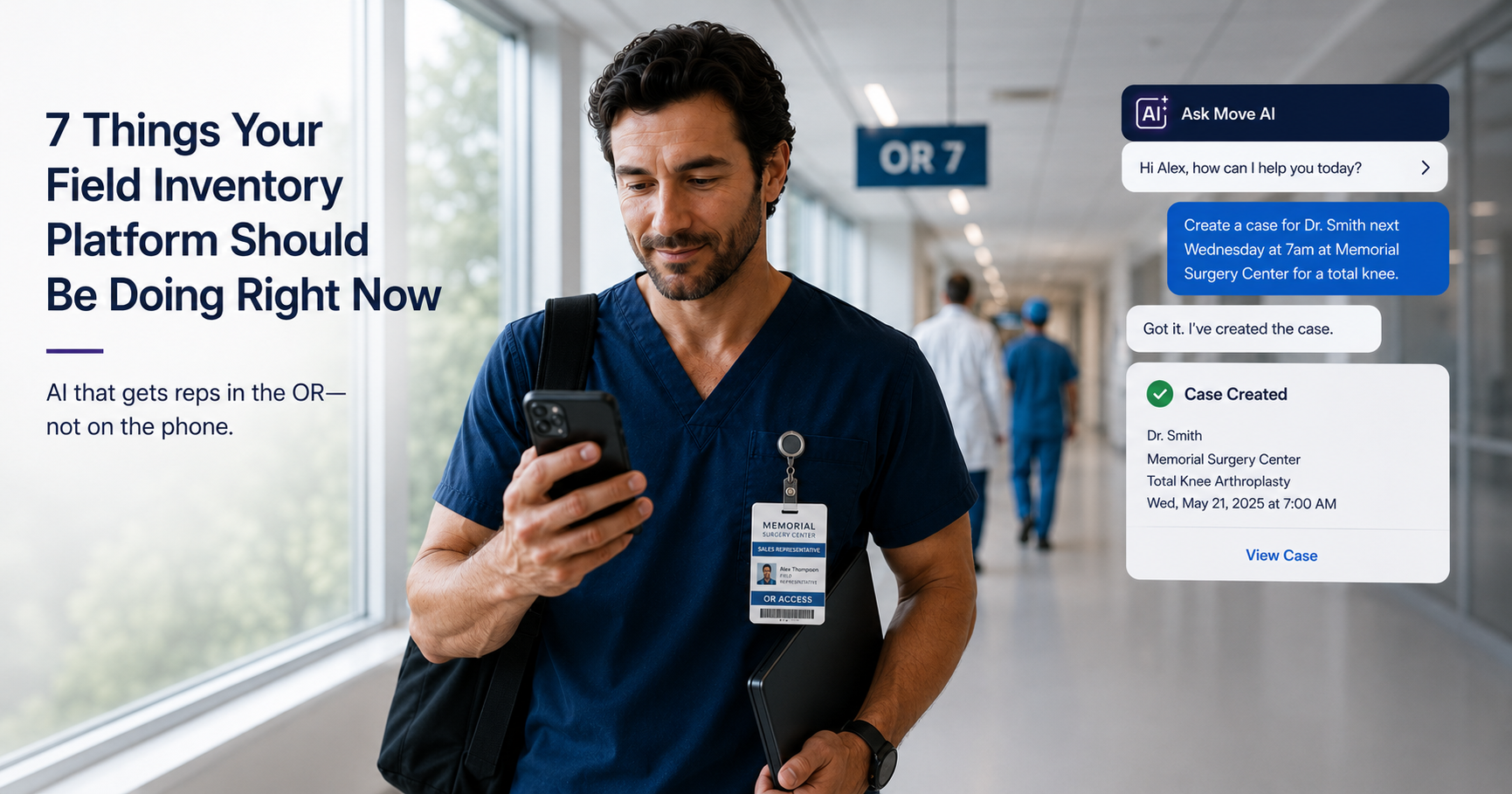
The best platforms alleviate that friction. AI-powered case creation, where a rep can describe a case conversationally by voice and have the platform populate physician details, facility information, procedure type, and inventory requirements automatically, is no longer a concept. It is in production. Reps are creating cases hands-free, from a parking lot, before walking into a hospital. And once a case is created, the same conversational interface lets them pull up exactly what is on it, check billing and invoice details, or reschedule a date and time, all without navigating screens or switching views.
The downstream impact is measurable: faster case confirmation, cleaner documentation, and reps who arrive at cases mentally prepared rather than administratively burdened. The technology is ready. The only variable is whether your platform has deployed it.
2. Giving Operations a Single Source of Truth
Ops teams at medical device manufacturers have become remarkably skilled at something they should never have had to learn: piecing together a complete picture of a case by hopping between modules, tabs, and reports. Shipment status here. Order confirmation there. Return tracking somewhere else entirely.
The cost of this fragmentation is not just inefficiency. It's risk. When a shipment exception gets missed because it's buried in a view no one checked, a case can go wrong. When a return isn't logged because the process requires too many steps, inventory reconciliation breaks down.
A consolidated view that puts every order, every shipment, every status, and every inbound return for a case onto a single screen is not a luxury feature. It is the baseline for a functioning field operation. Platforms that still require ops teams to hunt for information are leaving real cost on the table in labor, in errors, and in cases falling through the cracks.
3. Surfacing Inventory Risk Before It Becomes an Inventory Problem
Expired implants and at-risk inventory are two of the most persistent sources of write-down exposure in medical device manufacturing. They are also two of the most preventable if you get visibility right.
Most organizations discover expiry problems during a physical count or, worse, when a rep pulls a product that shouldn't have been used. That reactive posture has a cost: the lost inventory value, the compliance exposure, and the operational disruption of replacing products that should have been redirected months earlier.
Leading field operations software platforms flag these risks proactively. Expiry dashboards that surface inventory approaching end-of-life by location, backorder dashboards that give reps and ops teams real-time visibility into fulfillment gaps — these are not analytics features. They are risk management tools that pay for themselves in the first quarter they prevent a write-down or a missed case.
4. Letting Your Admin Team Run the Platform, On Their Timeline
Configuration changes are a regular part of medical device operations. Physicians change hospitals. Billing addresses get updated. Case types evolve. Audit requirements shift.
In many organizations, these changes require a support ticket and a wait. The business moves faster than the configuration can follow, and ops managers absorb the gap through workarounds that compound over time.
A modern field inventory platform puts configuration control back in the hands of the people who know the business best. Physician entry requirements, bill-to address management, audit outcome codes should be easily adjustable, without intermediaries, in minutes. Self-service administration is not a convenience. It’s the difference between a platform that responds to your business and one that constrains it.
5. Deploying Purpose-Built AI
The medical device field is not your typical supply chain problem. It involves highly regulated products, complex surgical schedules, last-mile logistics that no warehouse-centric system was designed for, and unforgiving compliance requirements.
Generic AI tools can describe these problems. They can’t solve them. The AI that creates real value in this space is built on nearly two decades of domain knowledge; trained on the edge cases, the exceptions, and the operational nuances that define how medical device actually works in the field.
This distinction matters most when something goes wrong: when a case gets stuck, when inventory signals a problem, when a rep needs an answer at 6am before a procedure. An AI system grounded in the deterministic rules of medical device operations — cases, orders, inventory, audit trails, compliance — responds to those moments reliably. One that was built for a different problem cannot. In practice that means a rep can create a case by voice, ask what is on it, pull up invoice and billing details, or reschedule a date and time — all conversationally, all on mobile, all grounded in the same compliant data layer that has been running their operations for years.
The question to ask of any AI capability your platform claims to have: was this built for medical device, or was it built for something else and pointed at medical device?
6. Running a Roadmap that Builds Momentum
Product release cadences matter. But the quality of a platform over time is not measured by any single release. It is measured by whether the investments compound. Whether the foundation being built today makes the platform meaningfully more capable six months from now, not just marginally more convenient.
The most consequential capabilities in field inventory management over the next 24 months are agentic: AI systems that don't just answer questions or surface information, but actively decide, act, and learn. Consignment optimization agents that recommend the right inventory at the right site before a rep asks. Demand forecasting that builds smarter coverage models based on actual case history and surgeon behavior. Inventory rebalancing that redistributes stock proactively, preventing shortages before they develop.
These are not capabilities bolted onto a platform as an afterthought. They are built as a layer designed to sit on top of a validated, auditable, compliant core — extending what the platform already does rather than working around it. They require an architecture designed for them from the start — an agent layer built on top of a validated, auditable, compliant core that ensures every automated decision can be traced, reviewed, and trusted. Organizations evaluating platforms today should be asking not just what a platform does now, but whether its architecture can support what the field will need in three years.
7. Treating the Field Rep Experience as a Strategic Advantage
Everything else in medical device field inventory is downstream of what happens when a rep is in the field. If the mobile experience is slow, unintuitive, or cluttered with steps that don't add value, reps find workarounds — and those workarounds cost accuracy, visibility, and eventually revenue.
The rep experience is not a UX conversation. It is an operational and commercial one. Reps who spend less time in the app spend more time with surgeons. Dashboards that surface the right workflows at the top without requiring ten taps to get there reduce cognitive load in high-pressure moments. Fast, reliable global search means reps find what they need when they need it, without digging through menus or guessing where information lives.
The platforms that understand this build every feature through the lens of what it costs a rep in time and attention — and they do it with direct input from the reps who live inside the product every day. That discipline shows. Not in any single feature, but in the accumulated experience of a team that moves from a day of cases to their app and back without friction.
The Benchmark Has Moved
The standard for field inventory management is not what it was three years ago. The manufacturers gaining ground in this environment are not doing it by running harder on the same systems. They are running smarter on platforms that eliminate the friction, surface the intelligence, and deploy the automation that their competitors are still waiting for.
Movemedical has Reset the Standard with the platform purpose-built for this moment while continuing to build what this industry will need next. From AI case creation, case inventory lookup, invoice access, and conversational scheduling in production today, to an agentic roadmap encompassing consignment optimization, demand forecasting, and inventory rebalancing — every capability compounds the one before it.
The field inventory management category is shifting. The only question worth asking is whether your platform is moving with it or whether it is asking your team to make up the difference.
Learn more about how leading MedTech manufacturers are running smarter field operations with Ask Move AI. Schedule an executive walkthrough and see the platform's AI capabilities and roadmap firsthand.
About the Author