Key Takeaways
- AI in field operations is only as good as the operational data beneath it — model quality is not the constraint.
- Most healthcare AI trains on how the system is supposed to work, producing insights that are theoretically right and operationally wrong.
- The working sequence is data first: capture real inventory, instrument, and procedure flow, then apply AI to it.
- The outputs are case readiness, fewer manual reconciliations, and an audit trail that holds — not a separate AI product.
- Movemedical supplies the deterministic data foundation the med device AI ecosystem runs on.
Artificial Intelligence has become one of the most overused and least understood terms in healthcare and medical device technology. Across the industry, manufacturers and hospitals are making bold claims about “AI transformation” and “AI hospital automation.” But in practice, most of these initiatives are built on incomplete or inaccurate data, which means the insights they produce are theoretical, not actionable.
Artificial Intelligence is as only as good as the underlying data.
At Movemedical, our approach is different. We start with reality (real data) and the actual flow of inventory, instruments, and procedures across the surgical ecosystem. Then we use AI to make that reality more efficient, not just more visible.
Why AI Fails On ERP Data and Works On Field Data
Most AI systems in healthcare start by creating a model of how the AI thinks operations should work, then layer intelligence on top of it. The result is a digital twin of a process that exists only in theory.
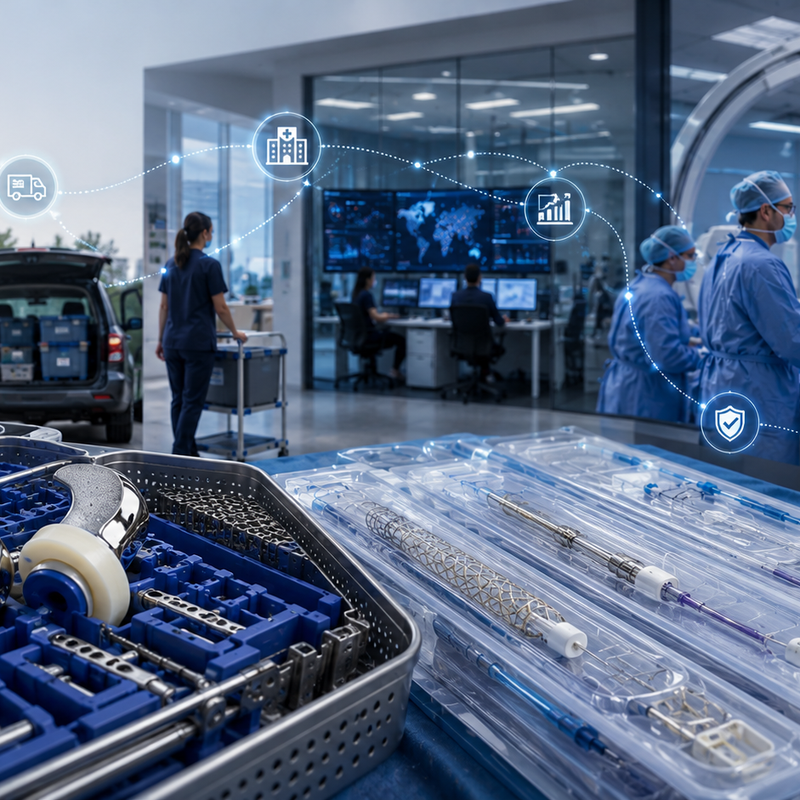
Movemedical’s advantage comes from having already spent more than a decade building the most complete and accurate operational data model in medical device logistics and hospital field operations. Our platform records every transaction of every tray, implant, and procedural event in real-time in the real world.
That data isn’t a simulation; it’s the true data signal that reflects how healthcare supply chains actually move.
When AI is applied to that kind of verified, contextual data, it becomes exponentially more useful. Predictions become accurate. Automations become reliable, and even more important: useful. And decisions become actionable.
As Bo Molocznik, Movemedical’s Founder and CTO, often says: “AI isn’t magic. It’s math on data. If your data isn’t real, your results aren’t real.”
Practical AI That Delivers Measurable Value
For Movemedical, AI isn’t a promise; it’s a tool that’s already at work. Today, we’re using machine learning to improve surgical demand prediction, helping hospitals and manufacturers know exactly what to prepare for each procedure. By analyzing historical case data and inventory usage and combining it with real-time future case schedules, the system can anticipate what will be needed and when, which reduces waste, avoids last-minute shortages, and saves valuable time in the O.R.
We’re also applying AI to case building and billing optimization, ensuring that every construct is accurate, compliant, and fair. And soon, intelligent assistants powered by large language models (LLMs) will give field teams and hospital staff instant answers to complex operational questions like, “Which cases are at risk next week?” or “Has everything been delivered for today’s surgeries?”
These are not experiments. They’re real, production-ready applications that make daily operations faster and smarter.
AI That Enhances (Not Replaces) Automation
While others talk about AI as a replacement for human effort, Movemedical’s philosophy is different. Our goal is to augment your human expertise, not eliminate it.
Healthcare should always be a people-led business. People make critical, life-saving decisions, provide care, and manage the complexity of thousands of moving parts every day. AI should make those people more effective, not obsolete.
That’s why our innovation roadmap is focused on applied intelligence: smarter automations, proactive task management, and adaptive workflows that respond instantly to changes in real-world conditions.
When a product is delayed, a shipment goes missing, or the case schedule changes; Movemedical will already know and take the next step automatically.
Fueling the Broader AI Ecosystem
Movemedical doesn’t just use AI; we power AI across the med device tech stack.
Because our platform captures the most accurate, real-time operational data in the industry, it becomes the foundation for other Enterprise data platforms like AI analytics, data lakes, and predictive engines. Without our unique, verified operational data, those systems can only make educated guesses.
Movemedical ensures their models are learning from truth. This makes our platform both foundational and indispensable. Enterprise AI tools can model trends and forecast outcomes, but they depend on Movemedical to feed them the real-world signal that keeps those forecasts grounded in reality.
In short: we make AI smarter.
Innovation with Purpose
In a market crowded with overpromised AI solutions, Movemedical’s approach stands out for one reason: it’s built on what’s real.
Our technology is already delivering measurable efficiency, accuracy, and time savings for global medical device manufacturers and hospital systems. And as automation and intelligence continue to advance, Movemedical’s role will only grow more essential, as the trusted operational layer that connects human decision-making with machine learning.
AI doesn’t need more hype. It needs better data.
Movemedical delivers both.
Ready to keep the conversation going?
Book a live demo with our Solutions Team to see the platform in action today.
About the Author