Rep-to-rep transfers are routine in medical device field execution. They keep cases covered and customers supported, often under real-time pressure.
The issue isn’t whether transfers should happen. It’s what happens when the system fails to capture them virtually, the moment they occur in the field.
For sales and commercial operation executives, that gap shows up in performance-critical areas: revenue timing, working capital, inventory accuracy, and compliance risk.
Most organizations know transfers are happening and that visibility gaps exist. Few have calculated the full financial impact. The cost is real, but rarely measured end-to-end.
In the sections below, we outline where the drag occurs, why it compounds over time, and what global MedTech leaders are doing to solve it.
The Overlooked Financial Impact of Field Inventory Transfers
Field inventory is spread across reps, trunk stock, field offices, consignment locations, and loaner pools. When rep-to-rep movements aren’t captured in real-time, reported inventory drifts from reality.
That drift affects billing, replenishment decisions, reporting accuracy, and financial performance—all contributing to adverse downstream impact MedTech enterprises can no longer afford to ignore.
Here are four (4) overlooked areas of concern:
1. Revenue & Billing Latency
When ownership isn’t clear at usage, billing slows.
Invoices pause while teams confirm who held the inventory. Revenue recognition slips. Finance resolves exceptions.
A field handoff that takes minutes can create days of back-office follow-up.
Repeat that pattern across dozens or hundreds of cases each month and the impact becomes material. Even a modest share of manual validations stretches billing cycles and delays cash collection, reducing revenue predictability and tightening cash-on-hand.
2. Replenishment & Working Capital Distortion
Without accurate location data, replenishment runs on partial information.
Teams either buffer with excess stock to protect service levels or react to shortages after they appear.
In both cases, capital is used inefficiently. Excess inventory ties up cash; reactive replenishment increases strain. Over time, inventory turns soften and confidence in planning erodes.
3. Inventory Accuracy & Chain-of-Custody Risk
When rep-to-rep transfers aren’t documented (virtually) at the moment they occur in the field (physically), inventory ownership and accurate location are much harder to verify.
Teams reconstruct movement history. Cycle counts become contentious. Audit prep expands.
The cost appears in write-offs, reconciliation effort, and added compliance scrutiny. And sometimes these costs, because they are often dispersed across functions, are easy to underestimate until they accumulate.
4. Sales Operations Friction
Inconsistent visibility affects trust.
Without a shared real-time view, teams create workarounds: extra meetings, parallel spreadsheets, manual checks. The work gets done, but more slowly, less accurately, and at higher cost.
Leadership is left questioning whether reports reflect reality or require interpretation.
____________
Why Traditional Systems Struggle with Field Transfers
Core systems were built for controlled, location-based movements: warehouse to warehouse, warehouse to consignment, consignment to usage.
Rep-to-rep transfers happen between individuals, quickly, and often outside formal facilities.
When tracked after the fact, system data lags field activity, forcing teams to reconcile gaps instead of preventing them.
What MedTech Leaders are Doing to Keep Field Activity and System Data Aligned
If field activity doesn’t match what the system shows, the fix must close that gap.
That's why top global MedTech leaders have chosen Movemedical as their trusted enterprise partner. Movemedical's powerful enterprise-level field inventory automation platform excels at capturing rep-to-rep transfers as they happen, and is designed to simplify daily rep activities, automate processes, and improve sales operation efficiencies at scale. In short, it's built to avoid the myriad hidden costs previously discussed. And the ease of use is second to none.
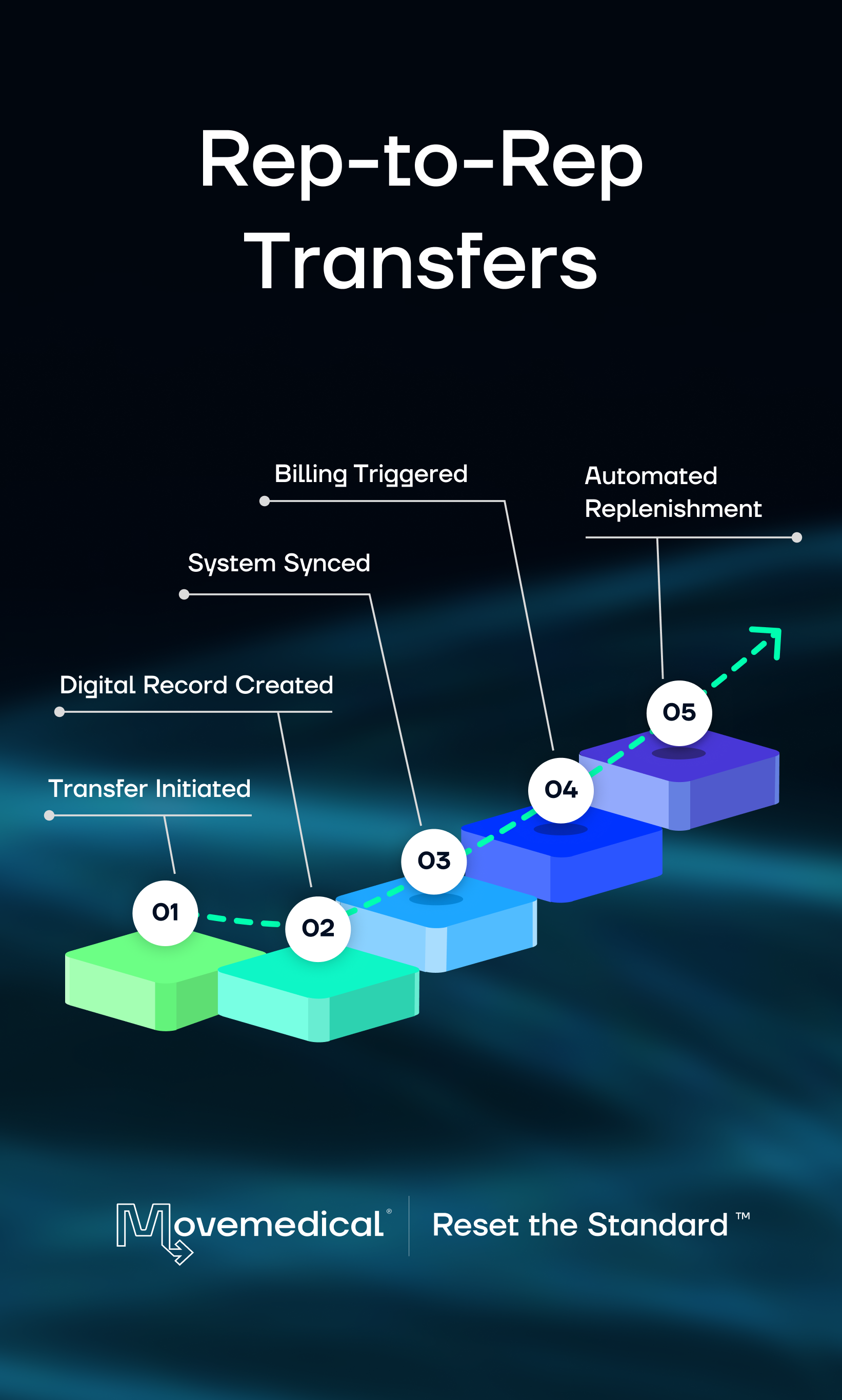
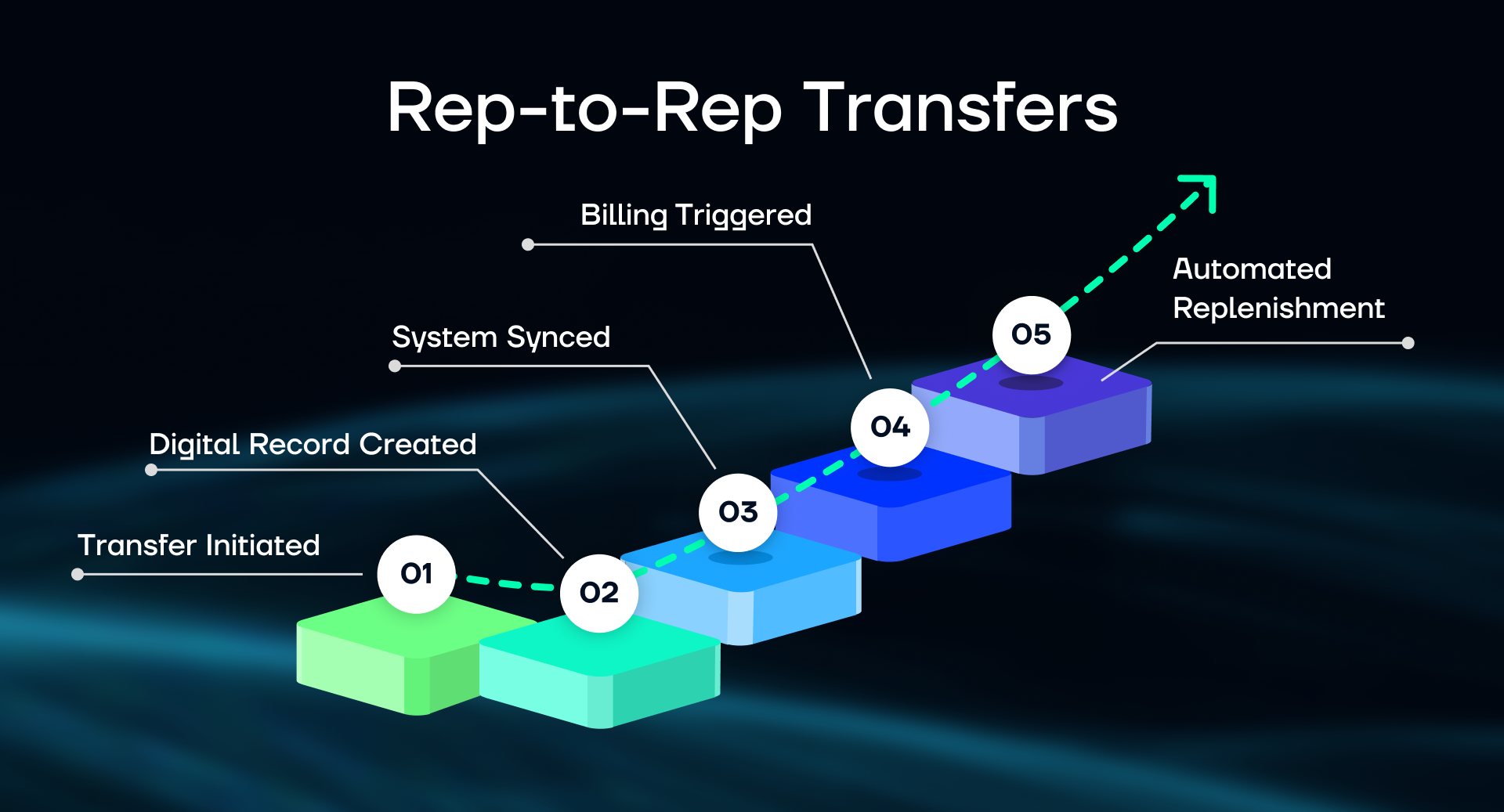
From the mobile app, a rep selects the receiving rep or location and scans the product. The transfer records instantly. If shipment is required, labels and documentation generate automatically.
There’s no separate process and no delay between action and system update.
Because mobile and web operate as one system, ownership updates in real time. Billing aligns with the correct rep and location. Replenishment decisions rely on accurate data.
Field activity and reporting stay in sync.
The Executive-Level Return
For commercial organizations operating at scale with Movemedical, real-time transfer visibility produces measurable impact.
Improved Revenue Velocity
With ownership captured at usage, billing moves without interruption. Fewer exceptions reduce back-and-forth between field and finance and limit delays tied to clarification.
Over time, smoother billing improves cash predictability and reduces revenue lag.
More Efficient Use of Working Capital
Accurate inventory positions align replenishment with true demand.
Instead of buffering with excess stock or reacting to shortages, teams plan with confidence. Inventory turns improve and capital is freed for higher-value initiatives rather than sitting idle in the field.
Lower Shrinkage and Compliance Risk
Each transfer creates a clear, timestamped record.
Reconciliation becomes straightforward, audit prep less disruptive, and avoidable write-offs decline. Long term, loss and compliance risk decrease.
Stronger Sales–Operations Alignment
Because transfer documentation is built into the Movemedical workflow, compliance becomes routine.
The operational impact is measurable. At Integra, internal phone, text, and email traffic dropped by 64% after implementation, signaling tighter coordination between field and operations teams.
At Gore, the average number of days orders remained unbilled declined by 26 days, tightening the connection between case execution and billing workflows.
Sales focuses on case coverage. Operations relies on accurate data. Leadership reviews reports without caveats. Alignment improves because the system supports how the field actually operates.
Making Field Reality Visible
Field inventory will move. Surgeons change preferences. Cases shift. Territories overlap.
The question is whether those movements are visible and controlled in real-time.
Movemedical makes them visible from the moment a transfer occurs, aligning field activity with billing, replenishment, and reporting. Instead of reconciling gaps later, commercial teams operate from a single, accurate view of inventory ownership.
Rep-to-rep transfers may seem routine, but how they’re governed has a measurable effect on revenue performance and working capital efficiency. With Movemedical, that governance is built into daily workflow, turning a common blind spot into financial clarity.
Ready to continue the conversation?
Schedule a 20-minute executive walkthrough to quantify the hidden costs of rep-to-rep transfers inside your organization.
About the Author