.png)
The latest pitch circulating in the medical device space sounds something like this:
"Don’t download an app. Just text us a photo. Our AI handles the rest."
It's a compelling pitch, especially if your operations teams are chasing POs through email threads or watching their headcount grow just to keep up with billing volume. The pain is real. But before you build your operations around a tool like this,ask yourself:
What happens when the lot number is partially obscured? What happens when AI misclassifies the PO type, and the error doesn't surface until it hits accounts payable?
And more important: what happens when your business doubles?
Task automation is not operational infrastructure
There's a meaningful distinction between tools that automate individual tasks and platforms that orchestrate entire operations. Both have value. But they solve fundamentally different problems, and confusing one for the other is one of the most common and costly mistakes a manufacturer or distributor can make.
Task automation tools remove friction from specific, repeatable workflows: parsing an email, matching a bill-only PO, triggering an entry in your billing software. For a small distributor processing a few hundred cases a month, that kind of automation can genuinely change day-to-day operations. The ROI is fast and visible.
But medical device operations aren't a collection of isolated tasks. They're a continuous, interdependent chain: a case is scheduled, inventory is allocated, kits are shipped, a procedure occurs, products are consumed, usage is captured, items are returned, billing is triggered, reconciliation happens, and the ERP is updated. At every step, something can go wrong. And when something does go wrong, it affects every step that follows.
Across hundreds of cases per month, even small errors in that chain create measurable revenue latency, billing disputes, and compliance exposure. A regional orthopedic distributor moving to a system-of-record platform reduced billing exceptions by more than 40% within two quarters of deployment; not by automating individual tasks or hand-offs, but by connecting the entire chain on a single verified data source.
Managing that chain requires a system of record that cannot be replicated by a language model making inferences from a series of photos sent from a phone.
Companies need infrastructure that’s built to last
One of the more persistent myths in MedTech is that enterprise-grade platforms are only for the largest Enterprise-scale companies, and that smaller med device manufacturers and distributors should start with something simple and "graduate" to something more robust later.
We've seen what that graduation costs. Deferring a plan for 18 months means eventually ripping out a system your reps adopted, migrating data from a platform that was never designed to export it cleanly, and rebuilding ERP, WMS, shipping and other integrations. In the end, you pay twice: once for the quick fix, and again for the platform you should have implemented from the start.
One thing we hear is that Mid-Market manufacturers and distributors don't need a fully-baked solution because they don't face the same challenges as their Enterprise counterparts. The truth is, Mid-Market medical device companies aren't simpler versions of Enterprise companies. They face the same UDI compliance obligations, the same audit exposure, the same distribution network complexity — and Movemedical is built to meet them where they are. The platform is modular by design, allowing Mid-Market organizations to deploy the capabilities they need today and scale into the full solution as their operation grows, without switching platforms or absorbing the cost of a failed transition along the way. That's the same foundation Enterprise companies run on — sized for the reality of where you are now.
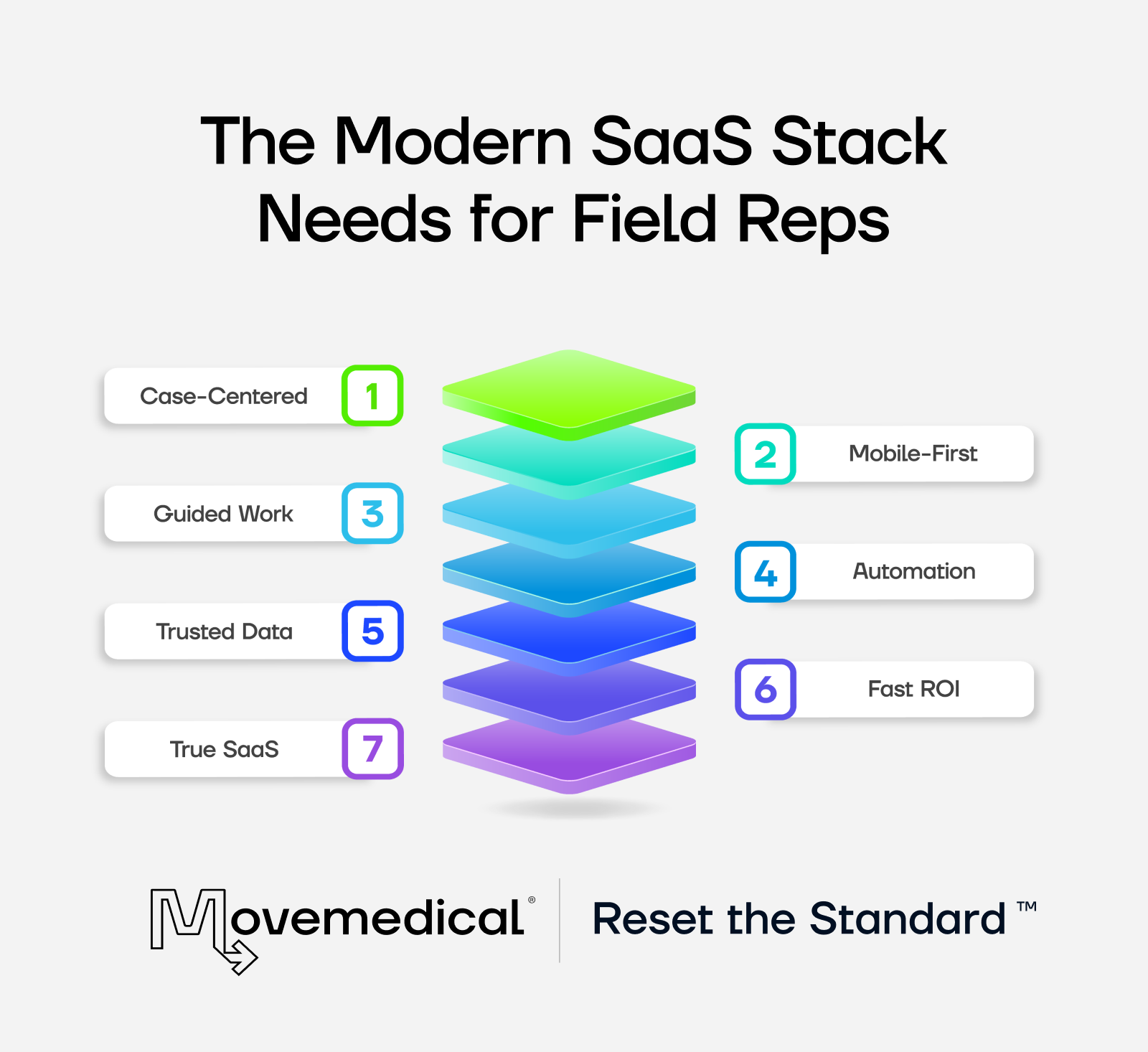
Both Mid-Market and Enterprise companies need is a platform that deploys in weeks without a major IT lift, scales with them as product lines, territories, and hospital relationships grow, integrates with existing ERPs rather than working around them, and gives field reps a real tool: a purpose-built mobile app with offline capability, barcode scanning, case planning, and usage capture; not a text inbox that guesses inventory management.
AI should enhance operations, not replace the infrastructure underneath them
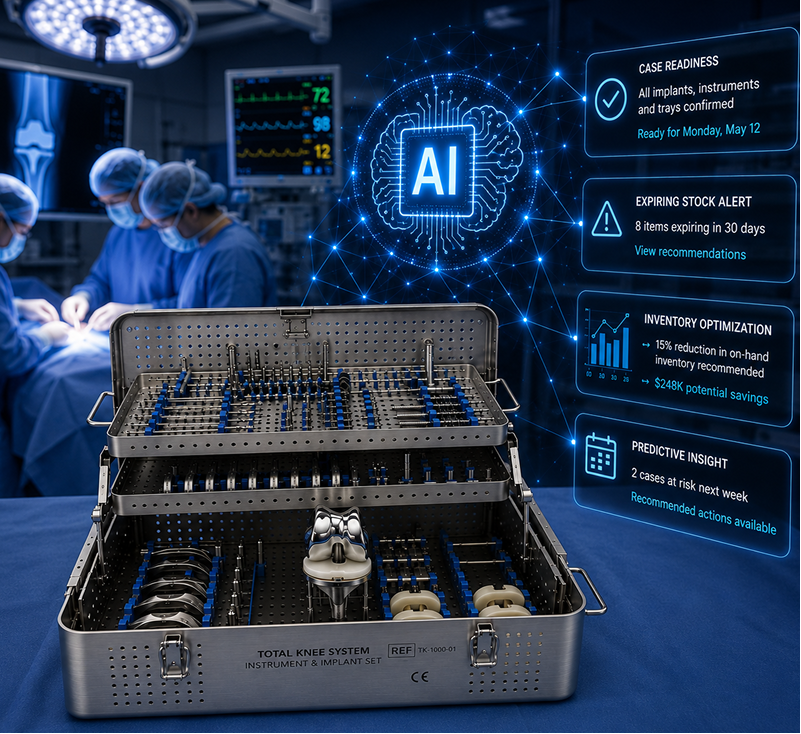
AI has a real and growing role in medical device operations, most notably in predictive demand planning, automated billing exception routing, and intelligent reorder triggers. These are meaningful areas where AI reduces manual loads on supply chain teams.
But there's a version of AI being marketed right now that asks organizations to accept a fundamental trade-off: replace your operational infrastructure with AI inference. Let the model read your photos, parse your emails, classify your POs, and trust the output to drive billing, inventory, and compliance decisions.
For low-stakes administrative tasks, this is a reasonable ask. For decisions that affect a patient's surgery, rep commissions, or a regulatory audit, the tolerance for inference error is effectively zero.
The medical device supply chain runs on trust. That trust is built on verified data from purpose-built systems. Automation built on top of structured, verified operational data enhances a process already grounded in reality. It doesn’t substitute for it.
What proven at scale really means for your evaluation
When evaluating any platform for field operations, the most important question isn't what it claims to do. It's what it has actually done.
Consider what that looks like in practice. A national orthopedic manufacturer running multi-ERP operations reduced days-sales-outstanding on bill-only use cases by 11 days after moving field usage and capture to a purpose-built platform without adding operations headcount during a period of 30% revenue growth. A cardiovascular distributor eliminated a category of billing exceptions entirely by connecting rep usage capture directly to their ERP, removing a manual reconciliation step that previously required two FTEs.
These outcomes aren’t the results of better task automation. They’re the result of having a single system of record that connects the field rep, the operations team, the warehouse, the hospital and finance through a refined and proven deployment process.
Mid-market companies can have the same foundation. Deployed in weeks at a total cost of ownership lower than many "lightweight" alternatives once you account for the IT lift, customization costs, and inevitable migration.
The question worth asking before you commit
If you're evaluating platforms — whether you're a mid-size orthopedic manufacturer trying to get off spreadsheets, a distributor tired of resolving billing exceptions manually, or a commercial ops team looking to unify a fragmented tech stack — the right question isn't which tool is fastest to start.
It's which platform you won't outgrow.
A live gap analysis with our team can give you a clear picture of where your current workflow is creating latency. In this 45-minute consultation we’ll show you where your audit exposure is, what incremental gains your teams can make, and what a transition timeline looks like to get you on the path to the ROI you need. Get a live gap analysis with us to see what we can do for you.
About the Author