When Fred Smith designed FedEx's hub-and-spoke system in 1973, every competitor was routing packages point-to-point — driver to destination, no central visibility. Packages disappeared between pickup and delivery with no way to know where they were until they arrived or didn't. Smith's insight wasn't faster trucks. It was that you couldn't manage what you couldn't see. Centralizing through Memphis gave FedEx a single picture of every package in the network at any moment. Competitors who kept running point-to-point lost accounts not because their drivers were worse — but because their customers couldn't get an answer to "where is it right now?"
Your reps are running point-to-point. And when a surgeon asks if the kit will be there, the answer too often is "I'll find out."
That answer is losing you cases.
The Case Loss That Doesn't Show Up on a Scorecard
Your best rep did everything right. They called on the surgeon. They confirmed the procedure. They showed up early. And then the case went to your competitor — because the tray was in the wrong city.
You absorbed the miss. The surgeon moved on. And your rep spent the rest of the week wondering what they could have done differently.
The honest answer: nothing. Because the problem wasn't their performance. It was the infrastructure behind them.
When a case is lost to a competitor because of kit unavailability, it rarely gets coded that way. It shows up as a missed opportunity, a scheduling cancellation, or a quiet gap in case volume. The real cause — a tray in the wrong location, untracked in someone's car or sitting at the wrong facility — doesn't surface in a CRM or a territory report.
This means field sales managers are absorbing quota pressure from a failure that's invisible in the data they're held to. The rep gets coached. The manager gets questioned. And the underlying problem — no real-time visibility into where surgical kits actually are — stays unsolved.
Across a territory running 20, 30, or 50 cases a month, even a 5–10% case disruption rate from kit availability issues is a material revenue problem. It's not a bad week. It's a structural gap.
Inventory Becomes Invisible the Moment It Leaves the Warehouse
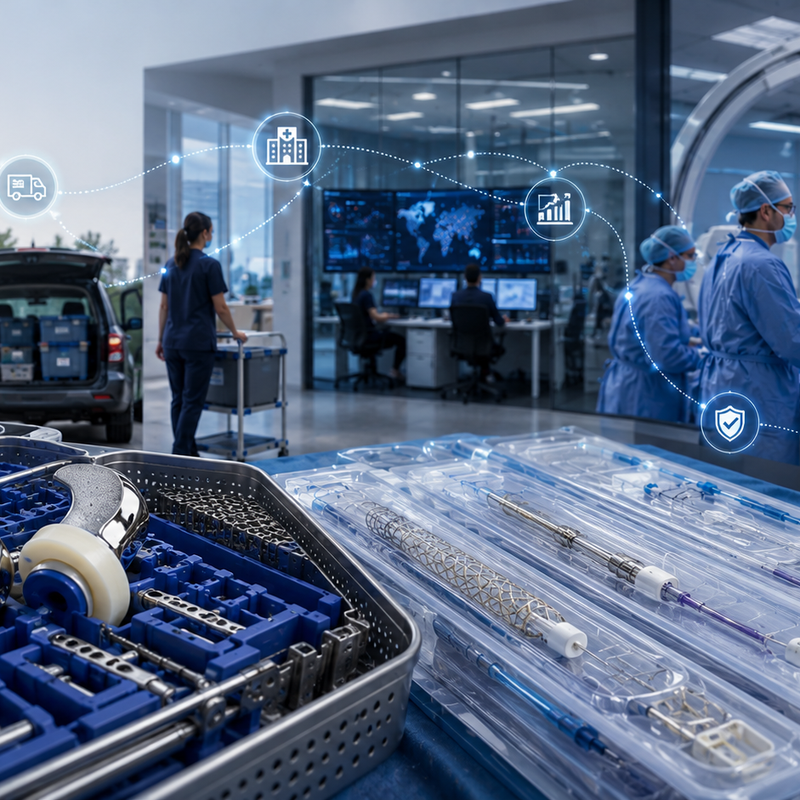
Most large MedTech companies have reasonable visibility into warehouse inventory. What they don't have is visibility into the last mile — the consignment locations, the loaner trays, the trunk stock in six different reps' vehicles, the kits sitting at a hospital that hasn't been restocked in three weeks.
Once a tray leaves the distribution center, it enters what amounts to a tracking dead zone. Reps know roughly where their kits are. Managers piece together a picture from memory, text messages, and phone calls. And when a case is booked and the kit isn't where anyone thought it was, the scramble starts.
The 6am call before a morning case isn't a rare event. For most field sales managers, it's a weekly occurrence. A rep, a missing tray, a case that can't wait. Three phone calls to figure out that the kit is at another rep's house — an hour away.
That's not a rep problem. That's a visibility problem. FedEx's competitors had drivers who knew their routes. They just couldn't tell you where any given package was at any given moment. Sound familiar?
What It's Actually Costing Your Territory
The most obvious cost is the lost case itself. But the downstream damage runs deeper.
When a case is canceled or delayed because of kit availability, the surgeon relationship takes a hit that outlasts the quarter. Surgeons don't forget the rep who couldn't deliver when it mattered. They remember the competitor who showed up with a complete kit on short notice. Over time, those moments accumulate into preference shifts that are very hard to reverse.
There's also the time cost inside the team. Every hour a rep spends tracking down a tray, making calls, or driving to pick up equipment that should have been available is an hour they're not in front of a surgeon. For a new rep still ramping, those hours are doubly expensive — their first 90 days should be building relationships and learning the clinical environment, not navigating manual inventory processes that slow them down before they ever get started.
And the manager absorbs all of it. The quota pressure, the surgeon relationship damage, the rep frustration. From a problem they didn't create and can't fix without the right infrastructure.
The Difference Between Knowing and Guessing
The field sales managers running the tightest territories share one capability their peers don't: they can tell a rep exactly where a tray is before the case is booked.
Not approximately. Not after three phone calls. Exactly — which facility, which consignment location, which rep is holding it, and whether it's available for the date in question.
That kind of visibility doesn't come from better spreadsheets or more disciplined reps. It comes from a system purpose-built to track field inventory at the last mile — not warehouse inventory, not ERP records that stop updating when product leaves the dock, but real-time kit location across the entire territory.
W.L. Gore & Associates faced the same last-mile visibility problem across a complex consignment model of vascular grafts and surgical meshes. After building real-time field inventory visibility, Gore achieved an 82% reduction in expired inventory — product that had previously been sitting untracked in the field long past its usable life. The root cause of expired inventory and lost cases is identical: assets that become invisible once they leave the warehouse.
Leading MedTech field teams using Movemedical's field inventory management platform give their managers exactly that visibility. Every tray, every kit, every consignment location — tracked in real time, accessible before a case is booked. The scramble before morning cases stops. The 6am call becomes unnecessary. And when a surgeon asks if a kit will be there, the answer isn't "I'll check" — it's yes.
The Structural Fix
Kit availability is a solvable problem. But it can't be solved at the rep level — individual reps tracking their own inventory in their own way will always produce gaps. It has to be solved at the infrastructure level, with a system that gives the entire territory a single, accurate picture of where every asset is at all times.
Smith didn't fix FedEx's visibility problem by hiring better drivers. He built the hub. For field sales managers absorbing quota pressure from a problem that isn't their fault, the conversation worth having isn't with reps — it's with operations leadership. The data to make that case is straightforward: cases lost or delayed per month, hours per week reps spend on non-selling logistics, ramp time for new reps burdened by manual processes.
The organizations that have made the infrastructure investment are protecting case volume and surgeon relationships that their competitors are losing. The gap between them and everyone else is widening.
See What Real-Time Kit Visibility Looks Like in Practice
Movemedical works with field sales and operations leaders at leading MedTech companies to eliminate the last-mile inventory blind spots that cost territories cases, surgeon relationships, and rep productivity. If your team is absorbing losses from kit availability issues, the problem is visible and solvable.
See how leading MedTech field teams protect case volume with real-time kit visibility — request a walkthrough.
About the Author