In 2002, the Oakland Athletics front office leadership made a decision that changed modern professional baseball. Armed with a payroll a fraction of the size of the team’s competitors, General Manager Billy Beane stopped trusting the metrics everyone else trusted and started asking a different question: what does it really take to win, and are we measuring the right things to get there?
The answer revealed that the entire industry had been optimizing around data that felt right but masked the real picture. Scouts had opinions. Managers had instincts. The numbers everyone tracked were the wrong numbers. The cost of that misalignment was baked so deeply into how the game was played that most teams never thought of questioning it.
Hospital Physician Preference Inventory (PPI) Management has the same problem. Most health systems aren't mismanaging their PPI out of negligence. They're measuring it with tools that were never designed to surface what actually matters — and absorbing costs they don't fully see as a result.
What the Scoreboard Isn’t Telling You
Most hospital operations leaders know PPI is complex. What they underestimate is how much that complexity costs, and the forms it takes. It comes as expired products written off, charges that go unbilled, and supplier reconciliations that drag on long after a case closes.
This isn't a workflow nuisance. It's a structural financial problem, and it compounds as you scale. And you see it in three sources of revenue leakage.
The first source of revenue leakage is product expiry. Without real-time visibility into where implants are and when they expire, non-compliant or expired devices can reach the OR without being flagged. When they're caught, the write-off cost is immediate, and the compliance exposure lingers. One leading hospital system identified roughly $3.5 million in preventable inventory expiry annually before deploying a purpose-built solution. That number didn't require a system failure. It required only the absence of proactive visibility.
The second source of losses are missed charges. When OR usage is captured manually, charges get missed. Clinical staff are focused on the patient, not on paperwork. Across hundreds of cases per month, even modest usage capture gaps translate into measurable revenue latency and cash that never returns to the organization.
The third source of revenue leakage is asset co-mingling. Owned, loaned, and consigned inventory move through the same physical spaces but require different handling across ownership, billing paths, and replenishment triggers. Without a platform that distinguishes between them in real time, hospitals end up with inventory sitting idle where it isn't needed while it's unavailable where it is.
Beane's insight wasn't that baseball was broken. It was that everyone was tracking the wrong indicators and calling it good enough. The metrics felt familiar, the process felt established, and the cost of the misalignment stayed invisible; until someone looked.
Why the Visibility Gap Outlasts Your Workarounds
The general instinct for most hospital systems is to solve problems with more processes: better checklists, more staff, tighter audit cycles. Some organizations try to configure their ERP to handle it. Neither approach works at the level the problem requires.
ERP systems were designed for predictable, organization-initiated transactions. They were not built for how hospital PPI actually moves. Implants arrive via supplier rep, sometimes without advance notice. Ownership can shift mid-procedure during a lot-swap. Usage is confirmed in the OR in real time, before any system has been updated. The chain from delivery to billing close involves clinical staff, supply chain teams, and external supplier systems that an ERP was never architected to coordinate.
Trying to make your ERP work like a purpose-built medical device tracking platform overburdens the system and creates data problems that require manual reconciliation downstream. The gap isn't a configuration problem. It's an architecture problem — and workarounds don't fix architecture. In fact, they often delay implementation of tools that could actually solve it.
The A's didn't win by asking their scouts to track more statistics. They won by changing the system entirely.
What changes when every handoff is captured
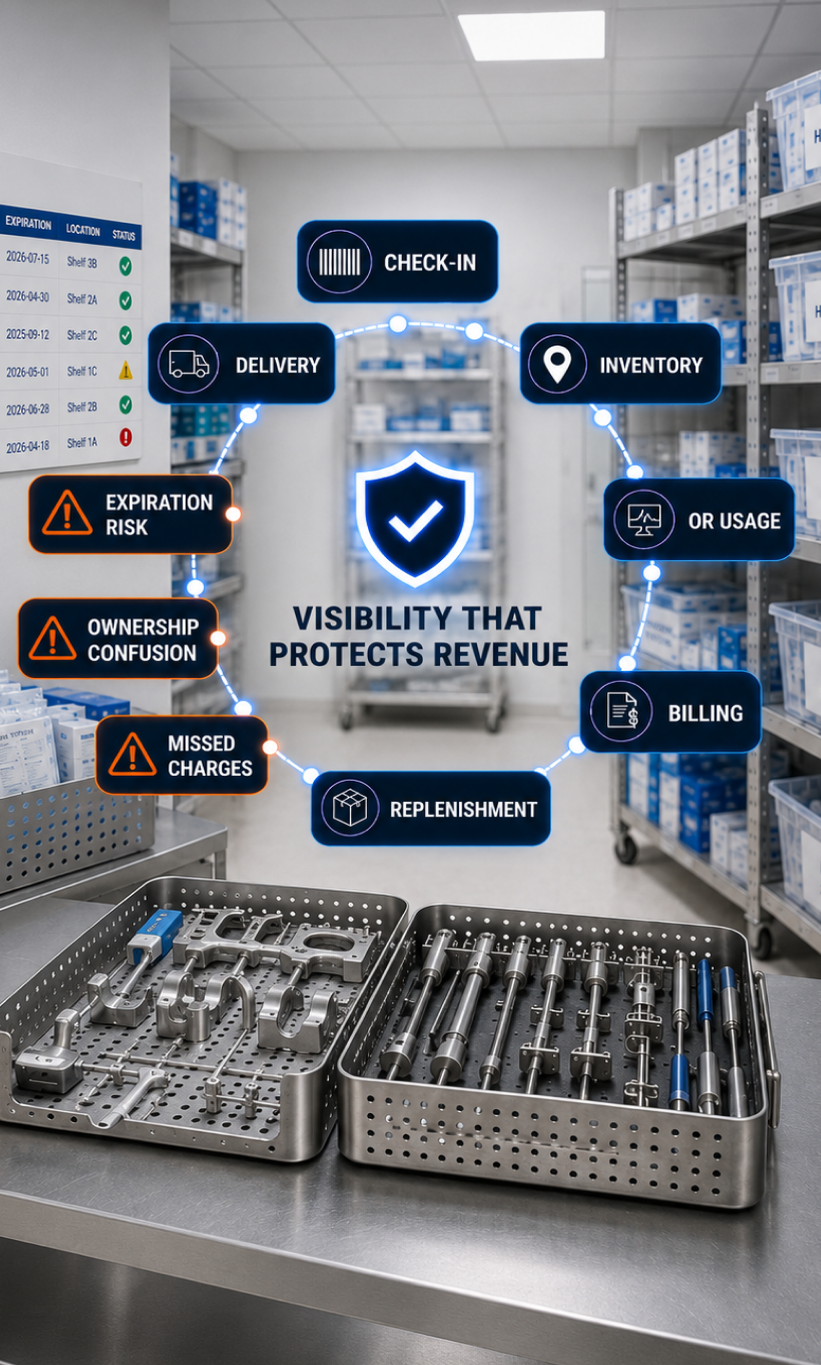
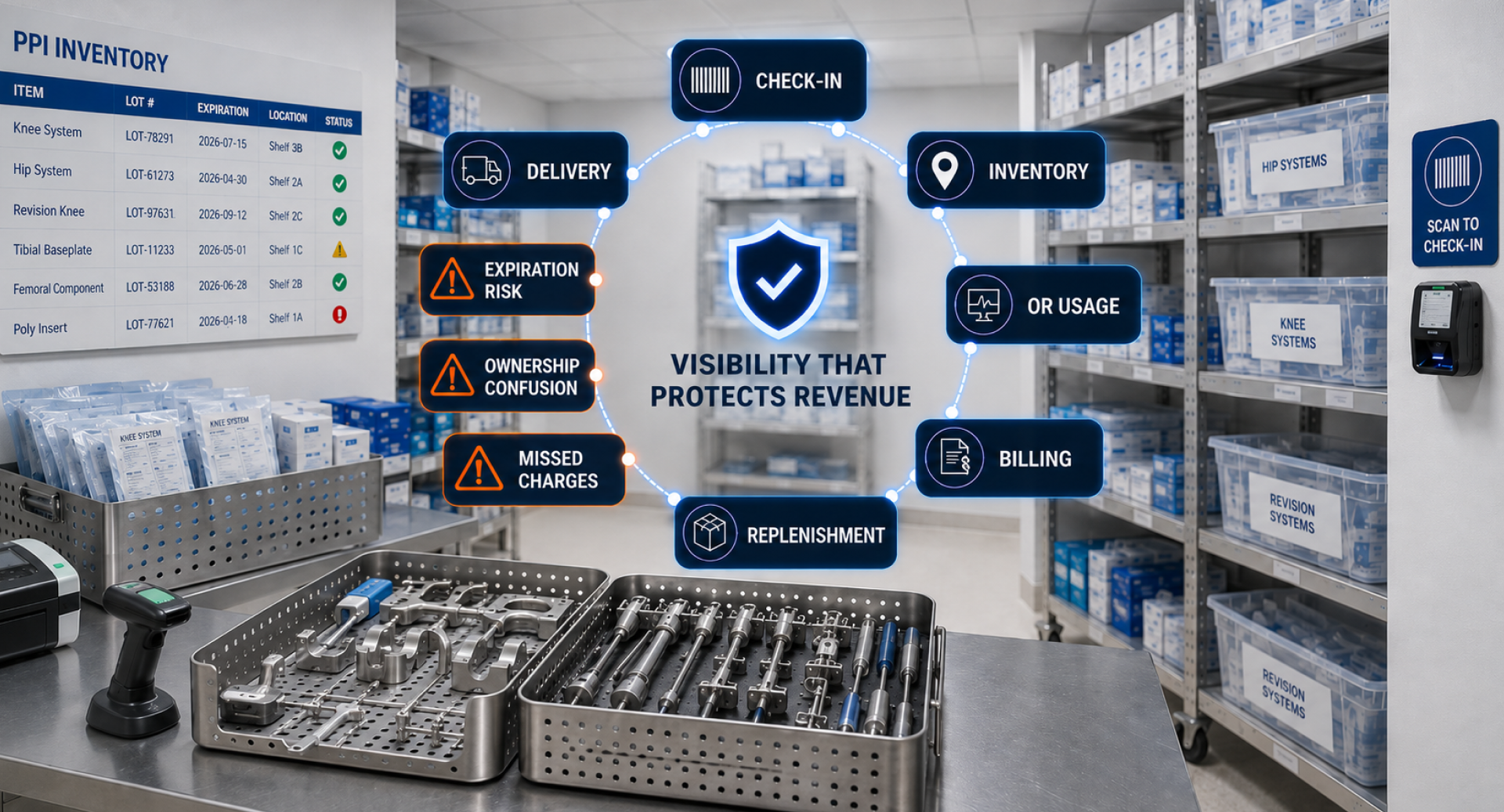
The alternative to revenue leakage and compliance risk exposure is using a platform built around how PPI actually moves through a hospital; from delivery and check-in, through location tracking and OR case usage, to billing submission and purchase order creation. When every step in that sequence is captured as it happens, the financial picture changes significantly.
Expiry is flagged before it becomes a write-off, not after. Usage is matched to the case at the point of care, not reconstructed days later. Charges are validated against contracts before submission, with built-in missed charge detection. Replenishment is triggered automatically, without relying on someone remembering to place an order.
Across more than 20 million surgeries, Movemedical has demonstrated what that operational reliability produces: supply chain control, accurate billing, full asset traceability, and better clinical outcomes. Hospitals using the platform have reduced unnecessary supply spend by 20 to 30 percent. The hospital system mentioned earlier went from $3.5 million in annual expiry exposure to zero expirations across every enrolled SKU.
Those aren't projections. They're the result of replacing manual processes and disconnected systems with a platform that was built specifically for this problem.
The decision in front of operations and IT leaders
Beane's competitors didn't lack data. They lacked a framework that connected the right data to the decisions that actually determined outcomes. By the time most teams understood what was happening in Oakland, the A's had already built a structural advantage that took years for the league to close.
The question for hospital operations leaders isn't whether PPI inventory management is broken at your organization. For most health systems, it is; not because of poor management, but because their tools were never designed for this work.
The question is how long to absorb totally preventable costs. Every month without real-time inventory control is another month of expiry risk, missed charges, and manual reconciliation burden your team shouldn't be carrying.
Movemedical integrates with your existing ERP and EMR. It doesn't replace your infrastructure — it fills the gap your infrastructure was never meant to cover. And like the shift Beane forced on baseball, the organizations that make this move first build an operational and financial advantage that is genuinely difficult to walk back.
Schedule a 20-minute executive walkthrough to see the financial impact quantified for your organization's specific inventory volume and case mix.
About the Author