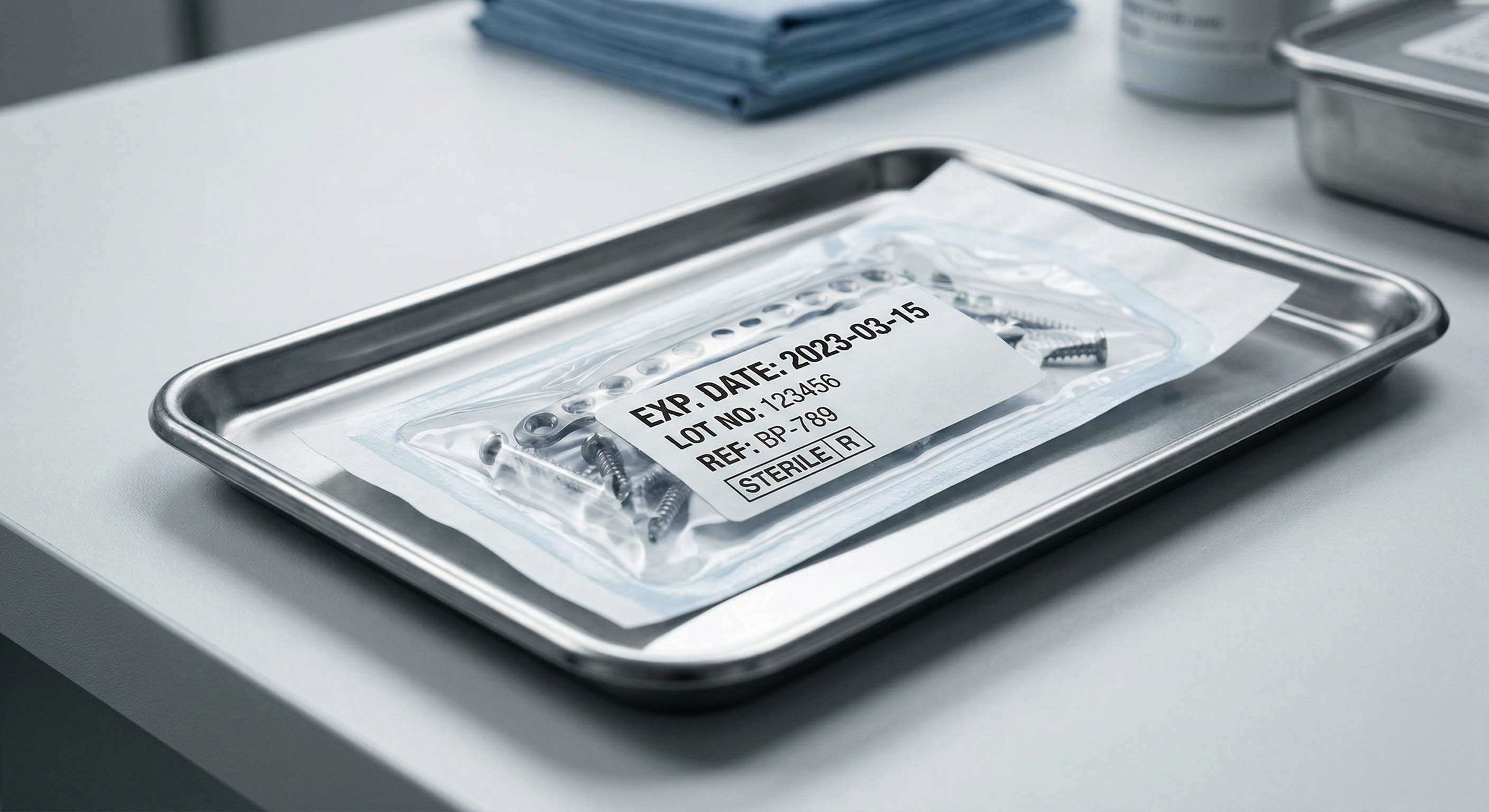
Expired product sitting in a rep's trunk or on a hospital shelf doesn't register as a line item on a P&L. It shows up later — in a write-off, in a failed audit, in a compliance incident that triggers a broader investigation. By the time leadership sees the number, the inventory has already been doing damage for months.
This is the compounding problem with expired consignment inventory in MedTech field operations. It's not an event. It's a condition.
The Visibility Gap Is Where Expiration Starts
Most field inventory expiration doesn't happen because no one cared. It happens because no one knew.
Consignment inventory distributed across territories, trunks, and hospital storage rooms is functionally invisible between physical cycle counts. An ERP can tell you what left the warehouse. It cannot tell you where that product is today, how long it's been there, or whether it's still within shelf life. That gap — the last mile between warehouse and point of use — is where expiration accumulates.
The practical result: by the time a rep discovers expired product at a hospital, it's already a problem with multiple owners. Operations has an inventory accuracy issue. Sales has a case coverage issue. Finance has a write-off. And if the product involved was implantable, the compliance exposure is orders of magnitude larger than the write-off.
What It Actually Costs
The direct cost of expired inventory — the write-off value of the product itself — is the smallest part of the problem.
The larger costs are structural:
Audit exposure. Expired consignment in the field is a compliance liability during FDA inspections and internal audits. When product tracking is manual and reconciliation happens after the fact, the audit preparation burden multiplies. Teams spend weeks reconstructing records that should be real-time.
Reorder distortion. Without accurate visibility into field inventory age and location, procurement teams can't distinguish between product that's available and product that's effectively lost. The result is over-ordering to compensate for inventory that's sitting expired in the field — compounding the working capital problem rather than solving it.
Rep time cost. The discovery and removal of expired inventory falls on field reps. Every hour spent pulling and reconciling expired product is an hour not spent in the OR. At scale, across a national sales force, this is a material non-selling time cost that ops leaders typically underestimate because it's distributed and invisible.
For one leading MedTech manufacturer, solving expired consignment inventory was part of a broader initiative that freed $220 million in working capital. The expired inventory problem wasn't the only driver — but it was one of the clearest signals that field inventory had never been properly managed in real time.
Why Manual Processes Don't Solve It
The standard response to expired inventory is a cycle count cadence — quarterly or annual physical reconciliation across field locations. The problem is structural: by the time a cycle count identifies expired product, it has already expired. The count is a lagging indicator of a problem that required a leading one.
Spreadsheets, rep-submitted reports, and ERP workarounds all share the same constraint: they reflect inventory as it was reported, not as it is. Field reps are not inventory managers, and the systems built for warehouse operations don't extend to the last mile of a commercial field model.
The result is a permanent condition where operations leadership is always one step behind the actual state of field inventory.
What Real-Time Field Inventory Visibility Changes
When field inventory is tracked in real time — by location, by product, by expiration date — the expired inventory problem shifts from reactive to preventable.
Specifically:
- Expiration alerts surface at-risk product before it expires, giving operations teams and reps a window to rotate or retrieve inventory rather than write it off
- Audit readiness becomes a continuous state rather than a periodic crisis — the data is always current, always reconciled
- Reorder accuracy improves because procurement is working from actual field inventory data, not cycle count estimates months out of date
W.L. Gore reduced expired consignment inventory by 82% after implementing real-time field inventory tracking through Movemedical. That result didn't come from a new policy or a tighter cycle count schedule. It came from replacing a reactive, manual process with a system that could see what was in the field before expiration made the decision for them.
That's the difference between managing expired inventory and preventing it.
The Window to Fix It Is Shorter Than It Looks
Field inventory expiration tends to accumulate quietly during periods of rapid growth, sales force expansion, or operational transition — exactly the moments when ops teams are stretched thinnest and least able to run manual reconciliation at the frequency required.
For MedTech organizations navigating leadership changes, rebrands, or compliance remediation, the urgency is compounded. The systems and habits that allowed expiration to accumulate don't correct themselves under new leadership. They require a structural intervention: real-time visibility into every consignment unit in the field, with expiration tracking built in from the point of distribution.
See How Leading MedTech Teams Prevent It
Movemedical gives operations leaders real-time visibility into field inventory — including location, quantity, and expiration date — across every rep, every territory, and every hospital storage location.
The teams that have solved the expired inventory problem didn't do it with better spreadsheets. They did it with a purpose-built platform that reaches the last mile of commercial field operations where ERP stops.
Schedule an executive walkthrough to see how your field inventory expiration exposure compares to industry benchmarks — and what it would take to close the gap.
About the Author