.png)
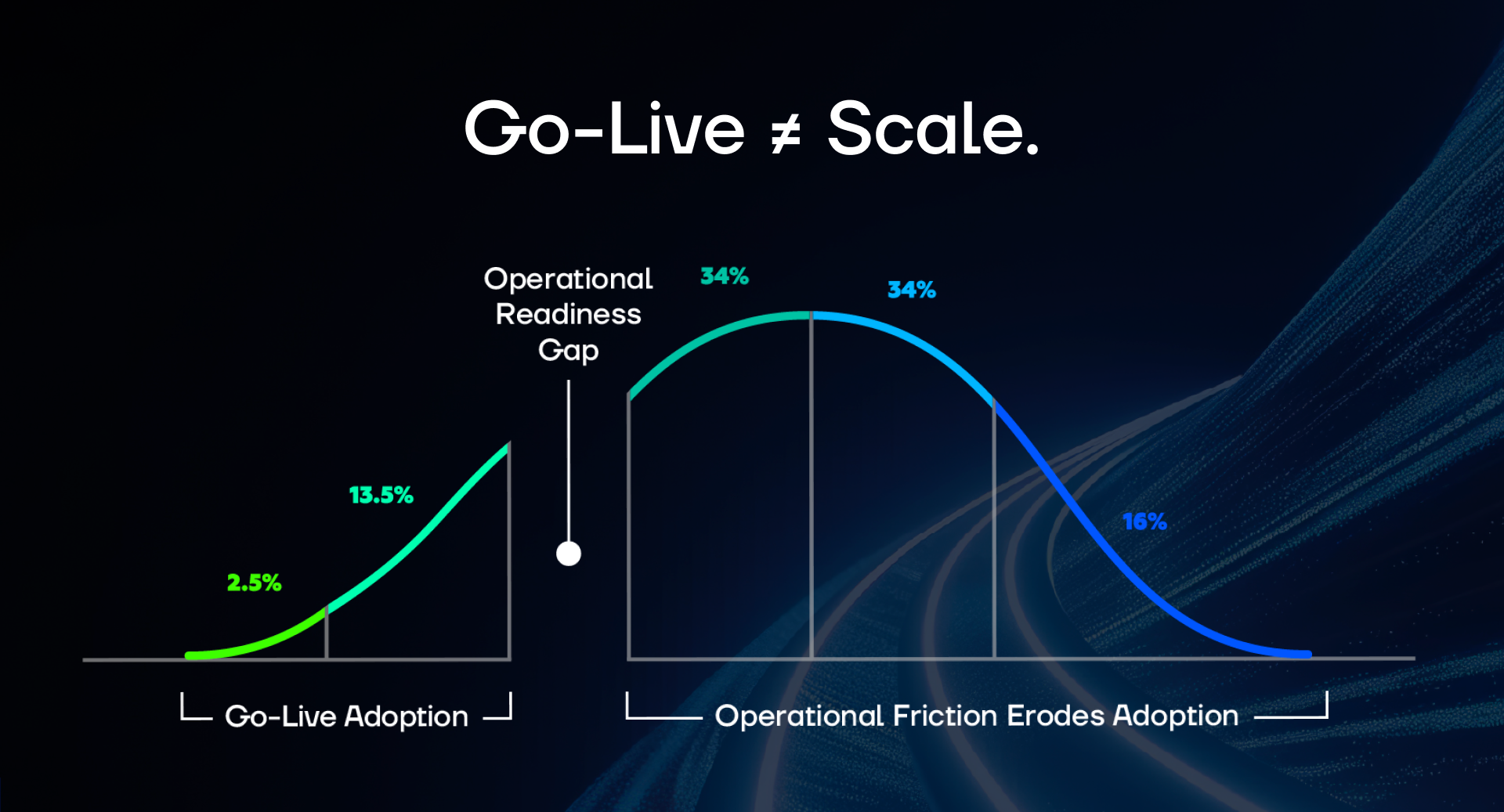
Most medical device organizations can point to a moment when things worked.
The integration went live. The bill-only process launched. The PPI program rolled out.
And for a while, it looked like success.
Then volume increased. Complexity followed. Exceptions multiplied. What once felt manageable became fragile. This is where scale breaks down; not because teams failed to integrate systems, but because integration and adoption were treated as separate efforts.
Integration and adoption are intertwined, and mastering their codependent relationship is the key to driving success with every technological initiative you undertake. Whether it’s a new ERP process, a customer service ticketing tool, or a field inventory management software, you need to have a plan to not just “go-live,” but to build momentum that translates into value.
The Illusion of Success at Go-Live
In MedTech, go-live is often mistaken for the finish line. But technical integration alone doesn't change how work gets done.
Organizations invest heavily in:
- ERP integrations
- EMR connectivity
- EDI transactions
Yet day-to-day execution still relies on workarounds, manual steps, and tribal knowledge.
When adoption isn’t designed alongside integration, the system works—but the operation doesn’t.
Bill-Only and PPI Programs Expose the Cracks in Integrations
Bill-only and PPI workflows are often the first places scale fails. Early on, manual processes can absorb complexity. But as volume grows:
- Usage capture becomes inconsistent
- Reconciliation lags behind reality
- Exceptions require constant intervention
- Reporting loses credibility
These programs depend on precise coordination across sales, operations, hospitals, and IT. Partial integrations or loosely adopted processes introduce risk at every handoff.
What starts as a workaround becomes an operational liability.
Why Integration Alone Doesn’t Deliver ROI
Technical teams do their job: systems are connected, data flows, interfaces are live.
But operational teams still ask:
- Who owns the process now?
- What happens when something breaks?
- How do users know what to do next?
Without clear workflows, accountability, and enablement, users revert to familiar habits. Shadow systems reappear. The intended benefits of integration remain theoretical.
Integration enables possibility. Adoption delivers outcomes.
Adoption Is an Operational System, Not a Training Event
Many organizations treat adoption as a one-time activity: training sessions, documentation, and hope that behavior will change.
At scale, adoption must be engineered. That means:
- Embedding workflows directly into daily operations
- Designing processes that reduce choice and ambiguity
- Providing visibility into status, ownership, and next steps
- Supporting users with role-specific training and ongoing reinforcement
When adoption is treated as infrastructure—not an afterthought—processes hold under pressure.
Resetting the Standard for Scale
Resetting the standard means recognizing that integration and adoption are not sequential steps. They are interdependent.
High-performing organizations:
- Design workflows at the same time systems are integrated
- Align sales, operations, and IT around shared execution models
- Build governance and accountability into the process itself
- Measure success by reliability and repeatability—not just uptime
This is how scale becomes durable rather than brittle.
Where Movemedical Fits
Movemedical is designed to support both sides of the equation.
Integrations are built to support real operational workflows—across bill-only, PPI, inventory management, and order fulfillment—while adoption is reinforced through embedded processes, visibility, and governance.
Instead of connecting systems and hoping behavior follows, Movemedical aligns systems and execution from the start.
The Takeaway
If your organization has “integrated” but still struggles with exceptions, manual work, or uneven execution, the issue may not be the technology you’re using. It’s how your integration and adoption were designed.
Scale doesn’t fail because teams lack tools. It fails when processes don’t hold under pressure. Movemedical helps medical device organizations identify where integration and adoption are misaligned, and how to reset the standard for scalable execution. If you’re preparing for growth or feeling strain from success, now is the time to evaluate whether your systems are truly built to scale.
Get a free gap analysis today and learn how you can turn reliability into real competitive advantage.
About the Author