For years, MedTech organizations have lived with a tension that leaves IT and Commercial teams at odds with each other.
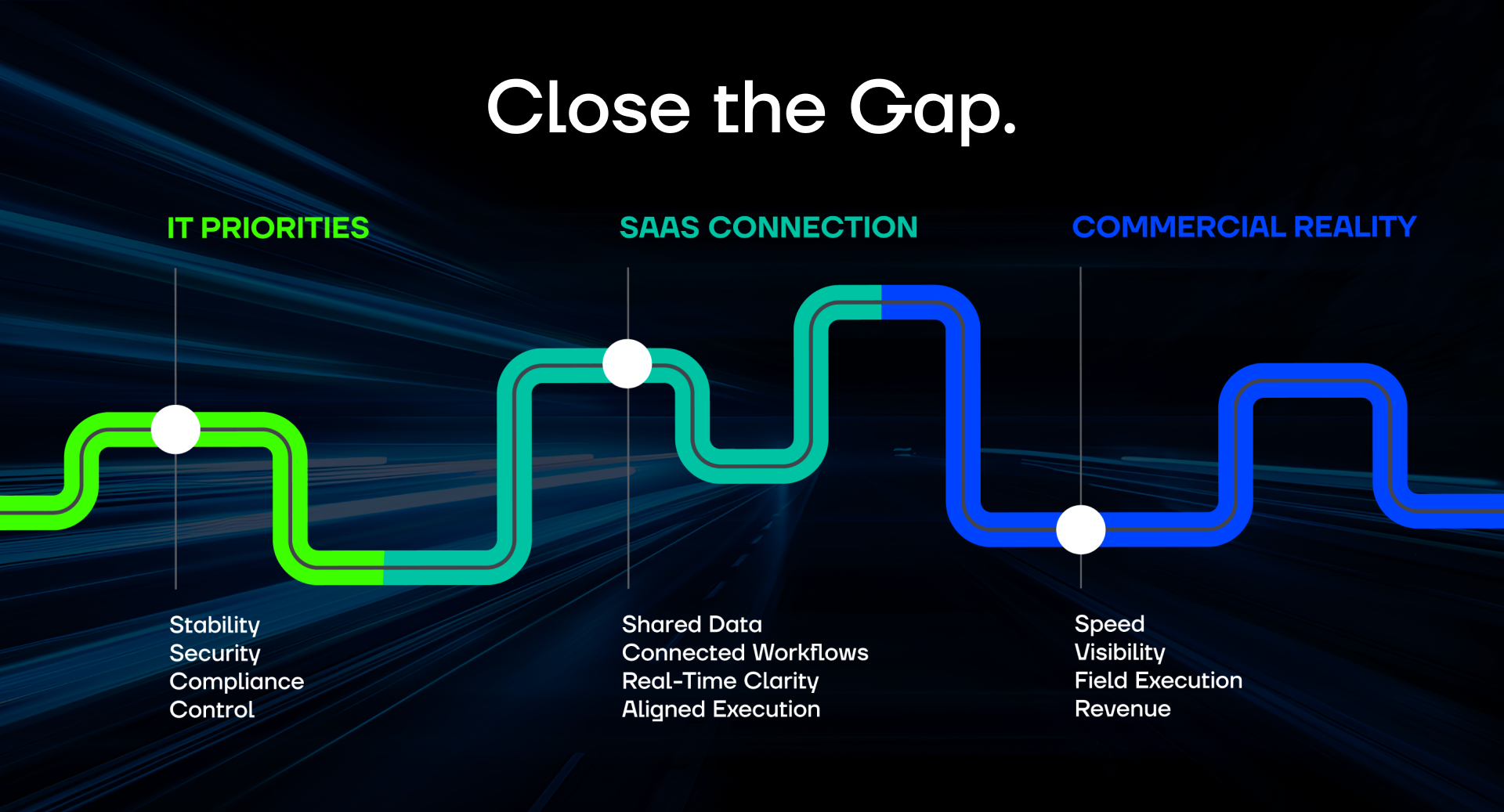
IT teams are tasked with keeping systems stable, compliant, and secure. On the flip side, Commercial teams are tasked with moving fast, responding to the field, and supporting revenue. Both missions are essential. Both teams have a strong sense of purpose. Both teams are strictly measured on what success looks like. But too often, the tools in place force these groups into competing priorities rather than shared outcomes.
And therein lies tension.
We often hear sales leaders say, “My priorities aren’t IT’s priorities.” And they’re not wrong. The source of this ongoing tension comes from a structural problem almost every MedTech company faces.
The good news is that this gap isn’t natural. It’s created by systems that don’t work together and were never designed to work together. And it’s a gap that MedTech SaaS platforms are finally closing.
Where Does the Gap Come From?
The divide starts with the tech stack itself.
Most MedTech organizations rely on one of three things:
- ERP systems that are stretched far beyond their intended purpose
- Fragile, custom-built tools that require constant vigilance and maintenance
- Manual workflows that fill the gaps between disconnected systems
On their own, each creates friction. Together, they form a perfect storm that slows execution, drives up operational costs, and forces IT to spend its cycles maintaining the wrong things. This totally undermines medical device inventory management and your ability to scale across teams and geographies.
IT ends up protecting system stability.
Commercial teams end up inventing workarounds.
The field ends up doing paperwork no one wants to talk about.
Meanwhile, leadership wonders why visibility is still murky and why nothing seems to scale cleanly.
Why Legacy Tools Can’t Bridge This Divide
The truth is simple: ERPs, homegrown apps, and disconnected modules can’t keep up with the real flow of MedTech operations.
ERP licenses for the field are expensive and unnecessary
Giving every field rep an ERP license costs you time and money as you make concessions that tax both your speed and autonomy.
Internal tools depend on internal resources
When a homegrown system breaks, the business doesn’t just lose functionality — it loses momentum.
IT can’t prioritize innovation when it’s stuck patching code and troubleshooting workflows it didn’t design.
Manual workflows create blind spots and bottlenecks
Paper audits, PDF transfers, sticker sheets, and email-driven handoffs all force your highest-value people into low-value work.
The cost is hidden but massive.
Most IT leaders already know this.
The problem isn’t seeing the gap — it’s having the time and bandwidth to close it.
Where SaaS Changes the Equation
Modern SaaS platforms succeed where ERPs and homegrown systems fail because they were built with different assumptions.
They assume:
- Systems should integrate cleanly.
- Updates should never require downtime.
- Mobile tools should be as strong as desktop tools.
- The field deserves autonomy without compromising compliance.
- IT shouldn’t have to build or maintain the workflows commercial teams rely on.
This shift is bigger than new software. It’s a new operating model.
A connected SaaS platform serves as a single backbone for field inventory, case workflows, transfers, replenishment, audits, expiry management, usage capture, and order-to-cash processes.
It lets ERP systems do what they do best while taking on the last-mile execution ERP tools were never built to handle.
The result: IT finally gets to lead with strategy, not firefighting. Commercial teams finally get technology that moves as fast as they do.
The Real Impact for IT Leaders
A strong SaaS platform does more than automate workflows. It actually reduces the strain on IT.
Fewer systems to support
Instead of maintaining custom tools or managing endless integrations, IT supports one platform that connects across ERP, CRM, and warehouse systems.
No more risky updates
Cloud-native architecture and zero downtime deployments mean patches and improvements happen invisibly in the background. No weekend cutovers. No outage windows. No tension.
Enterprise-grade compliance built in
Security and certifications aren’t projects to manage. They’re foundational components, baked into the platform so the entire organization stays aligned with regulatory expectations.
Configurability without custom code
IT guides governance while the business configures workflows within a supported framework. This keeps every team on the upgrade path rather than locked inside unique customizations.
This flips the traditional IT model from reactive to strategic. This becomes the core of real MedTech digital transformation.
And it gives IT something rare in MedTech: control without constraint.
The Real Impact for Commercial Teams
With the right SaaS platform, commercial teams don’t just “get a better app.” They get operational clarity they’ve never had before.
Sales moves faster
Mobile-first ordering, case prep, usage capture, and returns reduce manual work and eliminate the back-and-forth that slows reps down.
Operations gains real-time visibility
Every SKU, every movement, every expiry, every variance, every return — all in one place, updated automatically.
Customer support stops chasing information
Order-to-invoice becomes a clean, connected sequence with fewer touchpoints, fewer delays, and fewer escalations.
The commercial engine gets the precision it needs.
IT gets the stability it demands.
Nobody loses.
This Is How the Leading Platforms Close the Gap
The best SaaS platforms in MedTech don’t force a choice between stability and speed.
They deliver both.
They integrate tightly with ERP systems while owning the field-level complexity. They make adoption natural because they match how reps, planners, coordinators, and warehouse teams actually work. They create visibility IT can trust and commercial teams can act on.
And most importantly: They give MedTech organizations a unified picture of the truth so decisions don’t rely on guesswork, tribal knowledge, or manual reconciliation.
This is how the gap closes. Not with more meetings. Not with more custom builds. With platforms designed to support every part of your business, not just the parts your ERP was built for.
____________
The Future Belongs to Connected Teams
MedTech organizations don’t need more tools. They need the right system to bring their people, processes, and data together behind a common operational reality.
SaaS makes that possible.
It gives IT what it has always wanted — stability, security, scale — and gives commercial teams what they have always needed — speed, alignment, visibility.
When the whole organization runs on a connected platform, everyone finally shares the same priorities.
And that’s when the real work can begin.
Get a free gap analysis to see how you can better align your teams with the leading medical inventory software.
About the Author